There are 3 types of touchscreens: Resistive, Capacitive, and Infrared
Resistive:
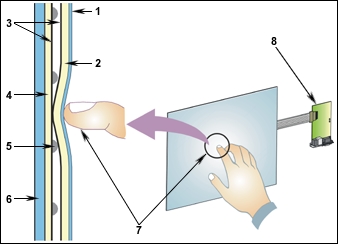
This is where there are 2 conductive layers with current going through them underneath the screen, seperated by tiny dots. When you press down on it the 2 layers touch and the electrical current changes at that point. The software then recognizes this change and reacts accordingly.
This is not the best type as you can only touch one point at a time and the screen does not look the best due to multiple layers.
Capacitive:
Unlike resistive, capacitive doesn’t use pressure to detect your finger, but instead works with anything that holds an electrical charge, including our skin. It is made from materials such as copper or tin that hold an electrical charge that is made into an electrostatic grid of tiny wires, each smaller than a hair.
There are 2 types of capacitive touch screens, surface and projective. Surface uses sensors at each corner and a thin film across the screen whereas projective uses a grid with a seperate chip for sensing.
In both Capacitive screens when a finger touches the screen a tiny electrical charge is transfered to the finger which creates a voltage drop at that point of the screen. The software recognises this voltage drop as a touch an acts accordingly.

Infrared:
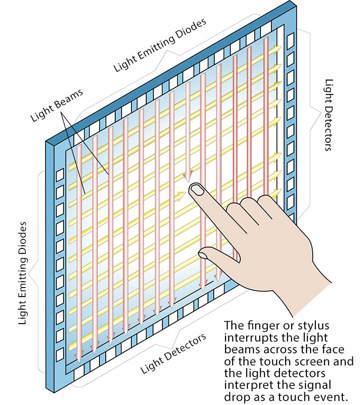
Infrared touch uses LED’s and sensors embedded around the edge of the display. This creates an invisible grid of infrared beams that have photo detectors on the other end of the beam. When you touch the screen, you break some of the lines. These breaks are detected by the sensors because there is no light being beamed onto it. This is used to determine the location of your finger and the software acts accordingly.
 Computer Science Notes