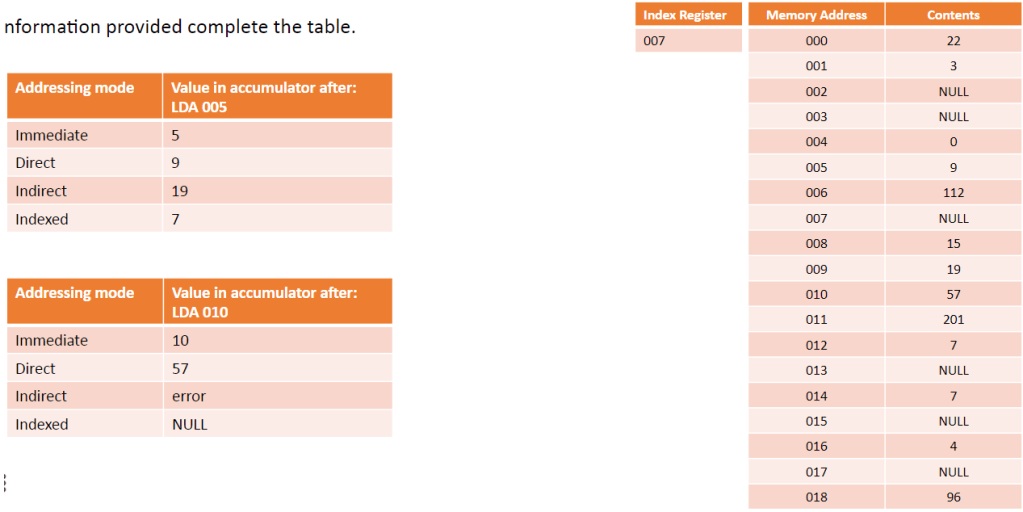
Immediate Addressing:
The instruction contains the data to be used. E.g: ADD 6 (add value 6 to accumulator)
This is the fastest method as it doesn’t involve having to go the the main memory.
Useful for carrying out instructions on constants opposed to variables.
Direct (or absolute) addressing:
The instruction points directly to a location in the memory. E.g: SUB 07 (sub value stored at memory location 07 from accumulator)
This method is fast but not as fast as immediate addressing. However, the code is dependent on the correct data value being stored at the location.
Indirect addressing:
The instruction points to a location in memory and the value stored here points to another location which stores the wanted value.
Indexed addressing:
An offset is added to the instruction and that is the location of the wanted value.
 Computer Science Notes